
Georgia DOC Release Paths
The Georgia Department of Corrections manages state-prison and state-corrections records. An Atkinson case enters this path after a state sentence or GDC commitment. Search the GDC Find an Offender page and Offender Query for the state record. A result may identify facility, sentence, offense, release-date information, and a photograph when available.
Leaving a GDC facility can mean discharge from prison, release to parole, or movement within the corrections system. A prison release does not always end the sentence. If parole follows, the State Board supplies the parolee lookup while DCS handles field supervision. Court records connect the original Atkinson sentence to the GDC record.
Confirm a Georgia DOC Release
Open the GDC Offender Query. Search by GDC ID or case number when possible because those identifiers reduce name confusion. Otherwise use the person's name and compare age, race, sex, county, offense, and case details shown. Open the matching record and read the facility, sentence, and release information in context.
- Identify whether an Atkinson court imposed a state sentence.
- Search by GDC ID, case number, or full name.
- Compare all identifying fields before choosing a result.
- Read location and sentence dates together.
- Check the Board's parolee search if release to parole is possible.
- Use the court file to connect the GDC record to the Atkinson case.
GDC guidance directs county-jail searches back to the county. A missing GDC result therefore does not disprove an Atkinson booking or county release. It may mean the person never entered state custody.
Georgia DOC Search Fields
A state offender result must be read as a state-corrections record. It does not describe every local arrest. The strongest match combines an identifier with personal and case details.
| Field | Release use |
|---|---|
| GDC ID | Direct identifier for the state offender record |
| Case number | Connects the result to a sentencing case |
| Name and personal details | Helps separate people with similar names |
| Facility or location | Shows current state placement when still confined |
| Sentence and offense | Explains the authority behind state custody |
| Release-date information | Shows the state-prison timing published by GDC |
The official Find an Offender page explains that photographs appear automatically when available. Its state record should be reconciled with the sentencing court and parole tools before treating one date as the end of all legal conditions.
Georgia DOC Records Contact
Use the public query first. For a question the online record does not resolve, follow the GDC contact and open-records route linked from the agency site. Give the person's full name, GDC ID or case number if known, the Atkinson sentencing case, and the exact state record requested. A focused date and document description helps the custodian identify responsive material.
Georgia Department of CorrectionsState offender information and records
General questions: 404-656-4661
Online: GDC Find an Offender
Georgia open-records law generally requires production, a timetable, or a lawful reason for withholding within three business days. That response period does not promise final production in three days. Ask for a fee estimate when a request could require extensive search, retrieval, or redaction.
The Atkinson clerk remains the source for the county sentence and later court orders. GDC is the source for the state custody administration. Keeping those requests separate prevents a county clerk from being asked for a prison movement record it does not maintain.
Georgia Sentence and Release Dates
Georgia Rules and Regulations 125-2-4 separates sentence begin date from sentence end date. The begin date accounts for the effective start, including jail time when appropriate and special sentencing instructions. The end date reflects maximum sentence length along with non-running time and earned-time effects. These terms explain why a date may differ from a simple count forward from sentencing.
Credit for time served can also shorten what remains after sentencing. A person may enter GDC after spending time in county custody that counts toward the sentence. Parole adds a different date. The Tentative Parole Month is a month for final review, not a promised release day.
- Discharge
- End of the applicable state custody or sentence status shown by the responsible agency.
- TPM
- Tentative Parole Month, subject to final Board review and conditions.
- Parole
- Conditional prison release with community supervision.
- Detainer
- Authority that may prevent release to the community or cause transfer.
Georgia DOC Results in Context
The official GDC search page is shown below as a visual reference for the statewide route.
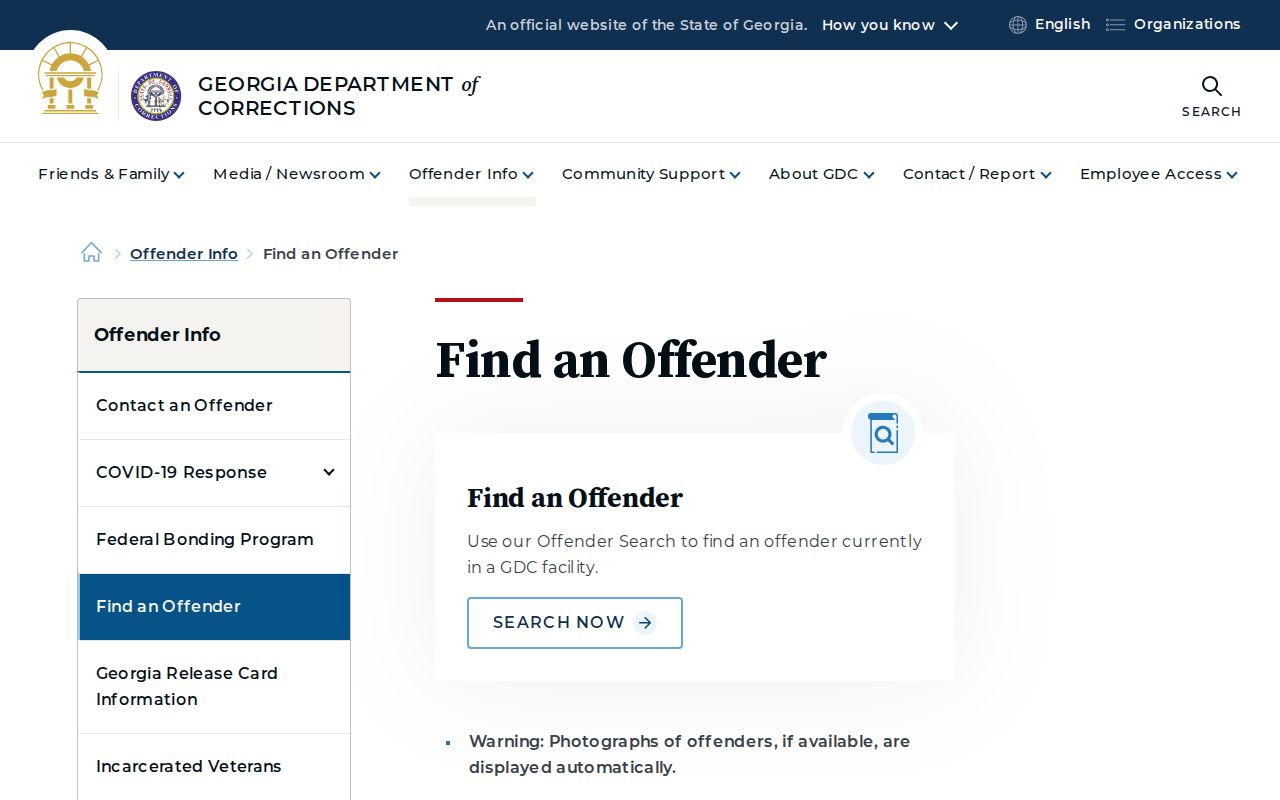
The image identifies the state entry point. It does not convert a county booking into a GDC record. Use it only when a sentence or transfer placed the person under state corrections authority.
For serious violent felonies listed in O.C.G.A. 17-10-6.1, mandatory sentencing and parole limits prevent use of a broad one-third assumption. The Board says most parole-eligible inmates reach statutory eligibility after one-third of the sentence, but few receive parole at the first eligibility point. Eligibility, TPM, and physical release are separate events.
After a Georgia DOC Release
When the record suggests parole, use the Board parolee database to verify the post-release parole layer. DCS supervises felony parolees, probationers, and people serving split sentences. The Lakeland virtual office serves Atkinson County in the Alapaha Circuit. A person can therefore be out of prison while still subject to state supervision.
If GDC reports transfer rather than release, follow the named receiving authority. No Atkinson ICE detention contract was found, but a documented immigration detainer can still lead to ICE custody rather than community release. Federal prison records belong to BOP, not GDC. The Atkinson County release search compares these custody paths.
The most reliable conclusion comes from matching three sources: the Atkinson sentence, the GDC custody and release record, and any Board or DCS supervision record. Each answers a different part of the release question.
Match GDC and Atkinson Records
Preserve the GDC ID, state case number, and Atkinson sentencing case when comparing results. A shared identifier is stronger than a name alone. If dates differ, ask which agency maintains the disputed stage. County jail credit, GDC sentence administration, parole review, and community supervision are separate events that can create several valid dates in one history.
A final check should identify the source of each conclusion. Use the Atkinson court for the sentence, GDC for state placement and release information, the Board for parole status, and DCS for felony supervision after release.