
Atkinson Parole Versus Probation
The State Board of Pardons and Paroles decides parole. Georgia Department of Community Supervision, or DCS, handles adult felony field supervision. A Georgia court orders probation. DCS supervises adult felony probation, while a sentencing court should identify the provider for a misdemeanor case.
| Record | How it begins | Where to verify |
|---|---|---|
| Parole | Conditional release from a state prison sentence after Board action. | Board Parolee Search, then DCS. |
| Felony probation | Court-ordered community supervision, including a probated or split sentence. | Sentencing order and DCS. |
| Misdemeanor probation | Local court sentence. | Sentencing court and the provider it names. |
- Parole
- Conditional release from prison before the maximum sentence ends.
- Probation
- Court-ordered supervision in the community.
- Split sentence
- A sentence combining confinement with probation.
- Discharge
- Formal end of custody or supervision in the system issuing it.
Verify Atkinson Post-Release Supervision
Start with the sentence type. The Board's TPM tool is for an inmate's tentative parole timing, while its Parolee Search is for a person already in the parole system.
- Use the Georgia Parolee Search for a possible parolee. Search by first name, last name, and race, then compare partial-name matches carefully.
- If the person remains in prison, use the Inmate TPM Lookup by six-digit inmate number, GDC ID, or personal data. A TPM is not proof of release.
- For probation, obtain the Atkinson sentencing order. Confirm whether it is felony or misdemeanor supervision.
- Use DCS's virtual-office listing to identify the Lakeland office serving Atkinson.
- For a formal public record, send a focused request to the Board, DCS, or sentencing court that owns it.
Names can repeat. A case number, date of birth, or GDC ID helps separate records. The Atkinson County release search can trace the custody event before supervision began.
Atkinson's Lakeland Supervision Office
DCS does not list an Atkinson felony supervision office in Pearson. It places Atkinson in the Alapaha Circuit and assigns it to the Lakeland virtual office with Berrien, Clinch, Cook, and Lanier. Confirm routing through the live DCS listing because a virtual office may use appointment or field arrangements that differ from a walk-in office.
Georgia Department of Community SupervisionLakeland Virtual Office, Alapaha Circuit
P.O. Box 633
Lakeland, GA 31635
For formal DCS records, contact the Open Records Custodian at 2 Martin Luther King, Jr. Drive SE, East Tower, Suite 866, Atlanta, GA 30334; fax 404-463-0327; or email openrecords@dcs.ga.gov. State the person, known identifiers, and exact record requested.
The DCS location source is shown below.
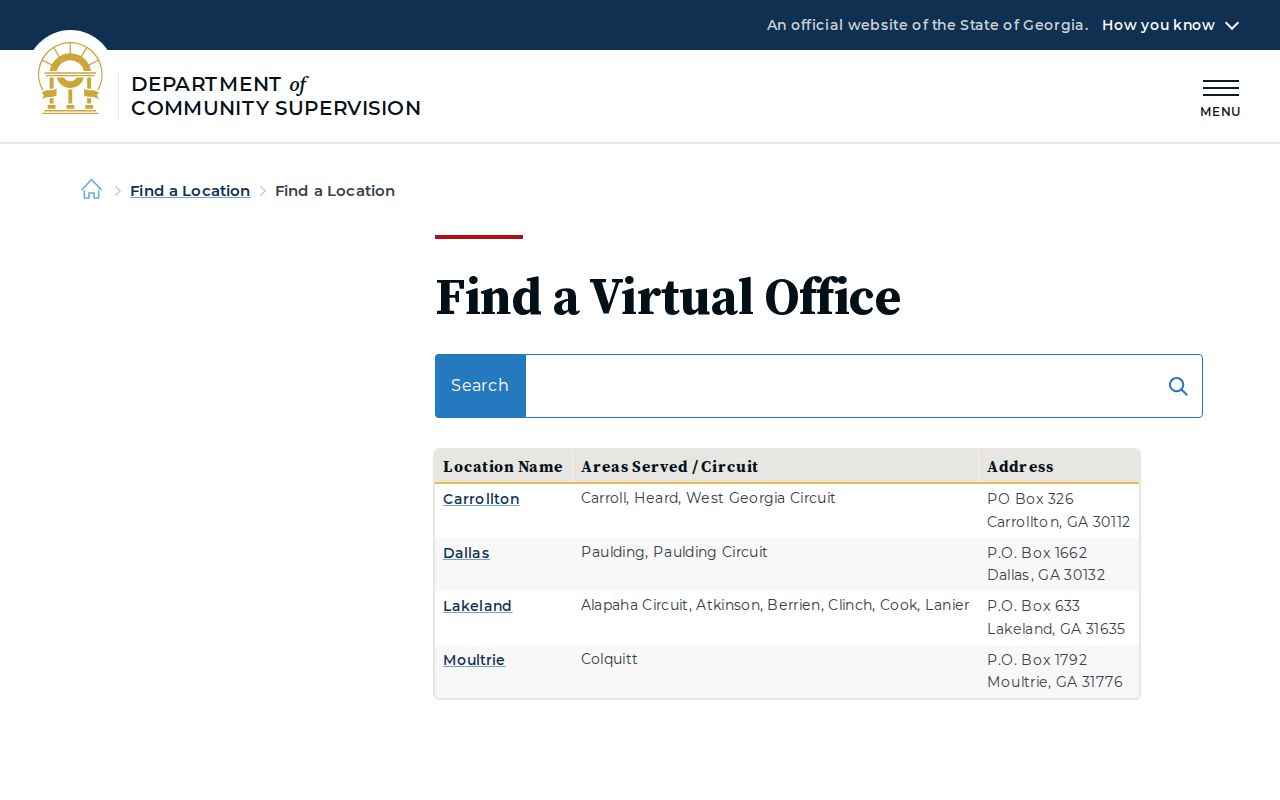
The listing confirms circuit coverage, not the status of a specific person.
Atkinson Supervision Status Changes
Conditions are the rules in a parole certificate or probation order. They can include reporting, lawful conduct, travel limits, treatment, fees, or other case-specific duties. Do not infer a condition from a general web page. Read the issued order or ask the supervising authority.
A violation allegation can lead to added instructions, a hearing, a warrant, or revocation proceedings. An absconder is a supervised person whom the agency reports as having stopped required contact or whose whereabouts are unknown. That label is not the same as a new conviction. Confirm any warrant through the court or issuing agency. VINELink may report a new custody change, but it does not replace the supervision record.
How Atkinson Supervision Ends
Supervision ends through a discharge or other formal agency or court action. Leaving jail is not the same event. A person released on parole remains subject to the parole record until the Board's process ends that status. A probationer remains bound by the sentencing order until the court or supervising system records completion, early termination, revocation, or another lawful change.
Use the final order or discharge record when exact status matters. If the online parole result is unclear, request the public record from the Board or DCS. For probation, ask the sentencing clerk for the docket and completion order. Restricted or sealed material may not be available to the public.
Why Atkinson Uses Lakeland
Atkinson's local detail is regional. The public DCS map serves the county through a Lakeland virtual office in the Alapaha Circuit rather than a Pearson listing. This affects where a person looks for felony parole or probation support and where an inquiry is routed. It does not shift control of misdemeanor probation away from the sentencing court.
Atkinson Parole Board Tools
The Board homepage separates two key searches. Inmate TPM Lookup concerns a person still in state custody and accepts a six-digit inmate number, GDC ID, or personal data. The Parolee Search concerns a person already released to parole and searches first name, last name, and race. Partial search terms can return several records, so identifiers and custody history matter.
TPM means tentative parole month. It is the month scheduled for final Board review if the case remains suitable and any conditions are met. It is not a parole grant. The Board may set a release date after review, delay or rescind tentative timing, or deny parole. A parolee result, by contrast, is a post-release supervision record.
The Board says most parole-eligible inmates are statutorily eligible for consideration after one-third of the prison sentence, but few receive parole at initial eligibility. Serious violent felony rules under O.C.G.A. 17-10-6.1 can limit ordinary parole expectations. Eligibility means review may occur, not that release must occur.
Georgia Parole Meetings Explained
The Board publishes monthly meeting notices and agendas through its press releases. Those public meetings address policy and operations. The Board expressly states that individual offender cases are not considered and parole decisions are not made at those meetings. A calendar notice therefore cannot be used as a personal parole hearing date.
Meetings may also be canceled. For a person's case, use the TPM and parolee tools or request the relevant public Board record. The Board press-release page supplies meeting notices, while the parole process pages explain case review.
The distinction prevents a common mistake. A public meeting in Atlanta is not evidence that an Atkinson County inmate's parole will be granted, denied, or decided that day.
Atkinson Probation Record Sources
DCS is the adult felony supervision agency. Its public material includes people granted parole or reprieve and people serving probated or split sentences. Misdemeanor probation may be handled under a local court arrangement. Do not assume the Lakeland DCS office holds every probation file in Atkinson County.
Read the sentencing order first. It identifies the court, length and type of sentence, and often the supervision route. For a felony, contact DCS after confirming the case. For a misdemeanor, ask the sentencing clerk which office or provider maintains the supervision record. Superior and Magistrate Court have separate local functions.
A probation record should be distinguished from the jail release log. The jail documents custody. The court creates probation, and the supervising body tracks compliance and completion.
Request Atkinson Supervision Records
For a DCS open-records request, include the person's name, date of birth when known, case number, GDC ID, and the specific public document needed. DCS lists its Open Records Custodian in Atlanta and provides fax and email channels. A narrow request for a supervision-status document is clearer than an open-ended demand for all information.
For parole, use the Board's search tools before contacting the Board. For probation, request the sentencing order from the correct Atkinson clerk. Public access can be limited when a record is sealed, restricted, juvenile, or protected by another law. A missing public result does not prove that supervision never existed.
Release Does Not End Supervision
A person may leave the Atkinson jail on a split sentence and begin felony probation. A GDC inmate may leave prison on parole. Another person may finish all custody with no supervision. The release record alone cannot tell which path applies unless it states the destination or condition.
Compare the release event with the sentence, Board result, and DCS record. If a later violation leads to custody, use the new jail or prison record for that event. The original release remains historically accurate even though the person's status changed later.
Public Record Search
Sponsored Results
Read Atkinson Parole Results
A parolee result confirms a place in the Board's parole system. It is not a current jail booking and should not be read as proof that every supervision condition has ended. Compare the person by name and identifying details, then use DCS for field-supervision routing.
An inmate TPM result answers a different question. It concerns tentative review timing before release. If no parolee match appears, the person may be on probation instead, may no longer be supervised, or may require a more exact search. The sentencing order and agency record resolve those possibilities.
Atkinson Supervision Court Orders
Probation begins with a court order. The order can define the term, conditions, credit, and whether custody and probation form a split sentence. Later filings can record modification, violation, revocation, completion, or early termination. Ask the clerk for the filed document rather than relying on a jail roster or an informal account.
Atkinson's Superior and Magistrate functions are separate. Use the court shown on the case record. If the material is restricted, sealed, juvenile, or otherwise not public, the clerk may lawfully limit access. That limitation should not be treated as proof that no probation record exists.