
Atkinson Projected and Actual Release
A projected date is a calculation based on the sentence record, credit, and rules in force. An actual release is the custody event after staff clear the judgment, holds, warrants, and administrative steps. A date in a record can change before that event. It also may describe the end of prison custody while parole or probation continues in the community.
A pretrial Atkinson detainee does not have a sentence-based end date. Bond, a dismissal, a plea, a court order, or transfer may change custody. For a sentenced person, identify whether the sentence is served in county jail or through GDC. Those systems use different records.
Find Atkinson Release Date Records
Begin with the sentencing and custody source. The county roster is not the state-prison calculator.
- Check the Atkinson Offender Index to identify current or prior local booking information.
- Call the jail at 912-422-3291 for a local custody check. Ask whether the person is pretrial, serving a county sentence, or transferred.
- Use the correct Atkinson court file for the judgment, sentence, bond order, and credit for time served.
- For a GDC offender, open GDC Offender Query. Search by GDC ID or case number when possible, then compare name and identifying details.
- Read the sentence and release fields in context. For parole timing, use the Board's Inmate TPM Lookup.
- Confirm with the holding agency near the stated date and use VINE for a reported custody change.
The Atkinson released-inmate lookup explains where a person may appear after leaving each system.
The GDC Find an Offender page leads to the state search shown below.
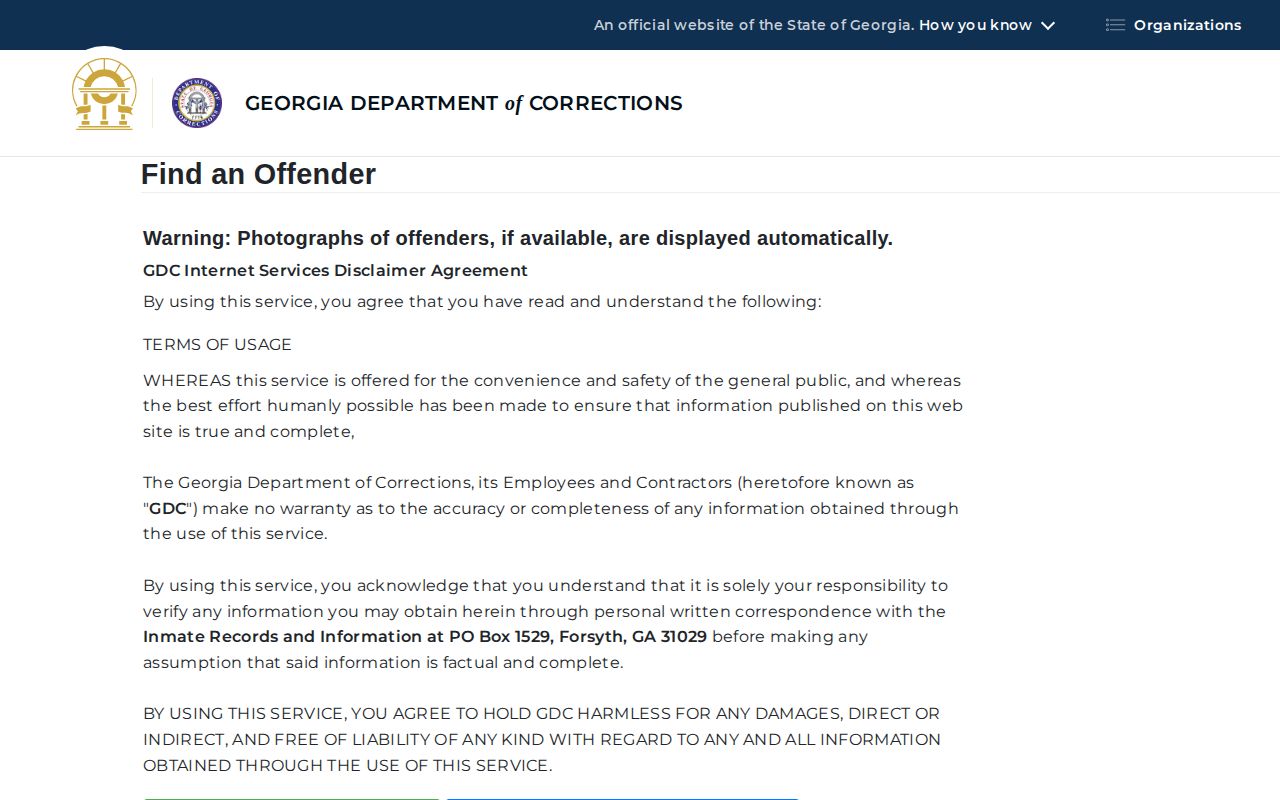
GDC covers state offenders. It does not replace Atkinson jail or court records for a local detainee.
Atkinson County Earned-Time Rules
O.C.G.A. 42-4-7 requires county inmate records and states that a county inmate sentenced to confinement is released at sentence expiration less earned-time allowances. That county rule should not be confused with GDC sentence dates or parole. Georgia corrections rules define a sentence begin date with applicable jail time and special instructions, and a sentence end date that reflects the maximum term, non-running time, and earned-time effects.
Credit for time served is another factor. O.C.G.A. 17-10-11 provides credit for confinement tied to the case. Thus, a person may have little time left after sentencing because earlier jail days count. For serious violent felonies, O.C.G.A. 17-10-6.1 imposes offense-specific mandatory terms and parole or earned-time limits. Georgia's rule should be cited directly, not reduced to a generic “85 percent” claim.
Why Atkinson Release Dates Change
A new event can alter either the calculation or the route out of custody.
| Factor | Possible effect |
|---|---|
| Bond or court order | Creates, revokes, or changes a pretrial release path. |
| Time-served credit | Reduces the unserved part of a sentence when lawful credit is applied. |
| Earned time | Can shorten a county or state calculation under the governing rule; forfeiture or correction can move it later. |
| Parole review | A TPM may advance, change, or end in denial after final review. |
| Hold or warrant | May prevent community release even when one sentence ends. |
| Transfer | Moves the person to Coffee County, GDC, another county, or federal custody rather than home. |
Required programs, prison conduct, sentence recalculation, and updated records may also affect parole timing. The source holding the person should explain which event controls.
Confirm Atkinson Release Timing
For county custody, ask the Atkinson jail whether all bond, court, and hold steps have cleared. For state custody, recheck GDC and the Board tool near the expected date. Register through the VINELink check when an alert is available, but reconcile the notice with the originating record. VINE reports a status change; it does not compute the sentence.
A release from one agency may be a transfer to another. If a detainer applies, use the receiving agency's locator. The court docket remains the best source for a changed judgment, dismissal, or sentence order.
Four Georgia Release Date Terms
Georgia records use several forward-looking dates that answer different questions.
- Sentence end date
- The calculated termination of a sentence under corrections rules.
- Parole eligibility
- The point when the Board may consider an eligible case, not a release promise.
- TPM
- A tentative parole month for final review if conditions remain met.
- Actual release
- The event when the person leaves that custody, possibly into supervision or another agency.
The Board says most parole-eligible inmates reach statutory consideration after one-third of the prison sentence, but few receive parole at initial eligibility. That statement concerns consideration, not a guaranteed Atkinson County release date.
Atkinson Earned Time Versus TPM
The distinction is especially important locally. County earned time under O.C.G.A. 42-4-7 adjusts a county sentence. A Board TPM concerns a state inmate's tentative parole review. Neither is the same as the GDC sentence end date, and none alone proves the person has walked out. The Board's TPM guidance states that the month is tentative and can depend on conduct or program completion.
Atkinson Pretrial Release Timing
A pretrial detainee has no sentence expiration to calculate. The next custody event may depend on bond, first appearance, a changed court order, dismissal, plea, or transfer. The Offender Index may show bond data, but the amount on a roster should be checked with the jail before payment. All Atkinson bonding is handled at the county jail even when the person is housed in Coffee County.
The sheriff says inmates may be bonded at any time, while cash and property bonds require money orders. That operational rule can affect when processing is completed. It does not create a projected legal date. Call the jail for the current amount, accepted bond type, and whether another hold prevents release.
If the person stays in custody, use the relevant court docket to track the next order. Superior Court handles felony proceedings, while Magistrate Court has its own jurisdiction. A court calendar date is not itself a release date.
Read Atkinson GDC Date Fields
Georgia corrections rules distinguish the sentence begin date from the sentence end date. The begin date accounts for the effective start, applicable jail credit, and special instructions. The end date reflects the maximum term plus non-running time and earned-time effects. A public GDC result may also show facility, offenses, and release information.
Match the GDC ID or case number before using the date. Names alone can identify the wrong person. If the state record shows released or discharged, check the Board's Parolee Search and DCS when community supervision may continue. A state prison release does not close the Atkinson court case or erase its disposition.
GDC says its Find an Offender path can supply facility and release-date information. The exact fields depend on the record. Do not fill a missing field by estimating from the sentence length.
Atkinson Holds and Transfers
A detainer is a request or notice that another authority wants custody or action when the current confinement ends. It can keep a person from walking free on the date one sentence appears to end. The next record may be in another county, GDC, federal custody, or immigration custody.
Atkinson research found no local ICE detention contract, so immigration language must remain conditional. If a documented ICE hold leads to transfer, use ICE Locator or DHS VINE. For federal custody, use BOP. For a move to GDC, use the state offender query. A transfer date is the end of one facility's control, not necessarily community release.
Request Atkinson Release Calculations
When online dates conflict, ask the agency that computes the sentence. A county request can seek the public inmate record, sentence information, earned-time entry, and release transaction. A court request can seek the judgment and time-served credit. A GDC inquiry should include the GDC ID and ask about the state sentence record.
Keep the date range and document description narrow. Georgia's Open Records Act generally calls for an agency response within three business days, although production time can depend on availability and lawful limits. A clear request helps the custodian identify the record without guessing what “release date” means.
Public Record Search
Sponsored Results
Atkinson Parole Date Review
The Board's TPM is conditioned on final review and may depend on good conduct or completion of treatment and other preconditions. A denial or deferment means the person stays in custody and may be reconsidered under Board rules. A rescission or delay can follow new conduct, changed records, unmet conditions, or another Board decision.
Public monthly Board meetings are not individual case hearings. The Board says those meetings address policy and operations and do not decide offender cases. Use the Inmate TPM Lookup for case timing, not the public meeting calendar. If the TPM tool shows no final release date, do not convert the month into a specific day.
Once a person is released on parole, the Parolee Search and DCS become relevant. The prison release date then marks the move from custody to supervision, not necessarily the end of the sentence.
Atkinson Credit for Time Served
Credit under O.C.G.A. 17-10-11 applies to days spent in confinement awaiting trial or connected to the sentence. The judgment and corrections calculation should show how credit was applied. A person can appear to leave soon after sentencing when prior jail time satisfies much of the custodial term.
Do not calculate credit from an arrest date alone. Periods can involve separate cases, release on bond, non-running time, or special instructions. Obtain the sentence and ask the record-owning agency for its calculation. That is more reliable than subtracting calendar days from a maximum term.